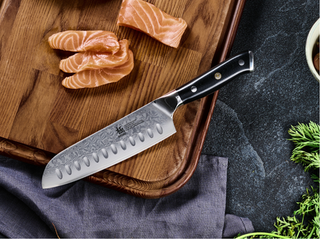
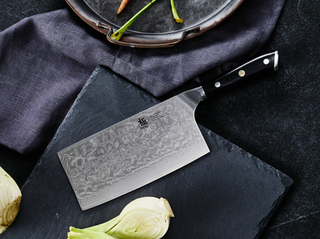

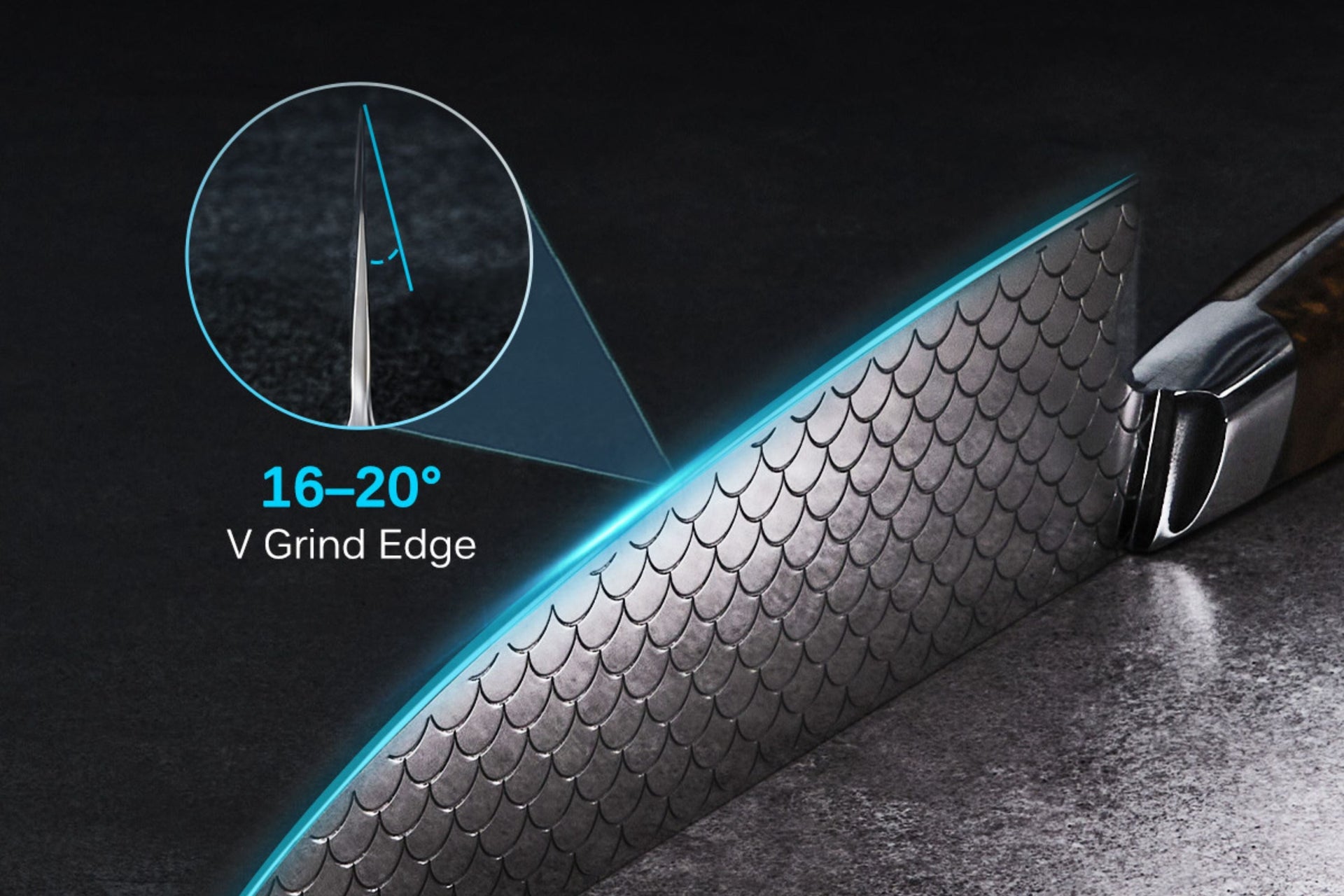
Generally speaking, there are more important factors, like blade geometry and steel type, to consider when sharpening a kitchen knife. However, when dropping from 20° to 15° per side (dps), there's such a noticeable boost in slicing performance that it's worth understanding exactly what each angle offers and whether it aligns with how you actually use your knife.
15 vs 20 Degree Knife Edge: Key Differences
The main difference between a 15-degree and a 20-degree knife angle comes down to the level of sharpness versus durability each provides. A 15-degree edge excels in sharpness, while a 20-degree edge offers more durability and resistance.
A 15-degree edge offers superior slicing and sharpness, which is why it's the standard for hard-steel Japanese knives. A 20-degree edge, on the other hand, provides more durability and better resistance to chipping, making it the go-to choice for thicker, softer Western or everyday carry (EDC) blades.

15-Degree Knife Edge: Pros, Cons, and Ideal Use
- Pros: Exceptionally sharp, easier to push-cut, and offers better edge retention, provided the steel is hard enough to support it.
- Cons: There's less metal supporting the apex, making the edge more prone to chipping or rolling when it meets hard objects (like bones or frozen foods).
A 15-degree angle is best suited to knives with high-carbon steel blades, particularly hard-steel Japanese chef knives (e.g., Gyutos).
20-Degree Knife Edge: Pros, Cons, and Ideal Use
- Pros: Highly durable and strong. The blade is also much less likely to chip, making it ideal for heavy-duty tasks.
- Cons: Marginally less sharp than a 15-degree angle, so it may require slightly more effort to push through dense foods like hard vegetables.
A 20-degree angle is best suited to Western-style kitchen knives (e.g., Wüsthof, Zwilling), as well as outdoor and pocket knives.
15 vs 20 Degree Knife Edge: The Core Differences at a Glance
| Feature | 15 Degrees Per Side (30° Total) | 20 Degrees Per Side (40° Total) |
| Performance | Laid-back, laser-sharp feel. Glides effortlessly through delicate tasks like slicing tomatoes. | Robust, working edge. Better for splitting dense root vegetables or handling frozen food. |
| Durability | Delicate apex. Prone to micro-chipping or rolling if used roughly. | High lateral strength. Absorbs impact well without rolling or chipping. |
| Edge Retention | High-performance longevity. Research (such as that by Dr. Larrin Thomas of Knife Steel Nerds) shows 15° actually retains cutting ability longer because it stays thinner as it wears. | Physical edge stability. Holds its geometric shape longer when slamming against hard cutting boards or bones. |
| Best Used For | Japanese kitchen knives and hard, high-end steels (60+ HRC). | Western/German kitchen knives and heavy-use EDC pocket knives. |
15 vs 20 Degree Knife Edge: Key Takeaways
1. The "Sharpie Trick" Works
A common method for verifying whether your knife is currently sharpened to 15° or 20° is the "Sharpie Trick." Paint the knife's edge with a black Sharpie before hitting the stones — the marker will scrape off in a pattern that instantly tells you whether your factory edge is closer to 15° or 20°.
2. Steel Hardness Is Everything
Western knives (like Wüsthof or Victorinox) use softer steel (around 56–58 HRC). If you sharpen them down to 15°, the edge will feel incredibly sharp but will quickly roll over under heavy use. Hard Japanese steels (60+ HRC), by contrast, can easily support a 15° or even lower apex without rolling.
3. The Hybrid Solution (Microbevels)
Many user experiences suggest the ultimate setup is a 15° primary bevel with a 20° microbevel. You grind the knife thin at 15° for effortless cutting geometry, then apply 3 to 5 light strokes at 20° at the very end to give the apex extra strength.
4. Re-profiling Takes Work
Changing a knife from a factory 20° down to 15° means removing a significant amount of metal. Doing this by hand on a high-grit finishing stone will take hours; you'll need a coarse stone (300–400 grit) to "thin the shoulders" first before refining the edge.

15 or 20-Degree Knife Edge for Japanese Knives?
When sharpening a Japanese knife with a whetstone, aim for a 15-degree angle per side. Most traditional Japanese kitchen knives are optimized for this angle thanks to their high steel hardness (usually 60+ HRC), a hallmark of what makes Japanese knife steel so well-regarded in the first place.
Why 15° Works Best on Whetstones
- Steel capability: Hard Japanese steel (like VG-10, SG2, or carbon steels) can hold a very thin, acute edge without rolling over or dulling quickly.
- Better geometry: A 15° angle takes advantage of the knife's thin spine, allowing it to glide through hard vegetables like carrots without wedging or splitting them.
- Whetstone precision: Sharpening by hand on a stone lets you feel the bevel sitting flat against the surface. A 15° angle is roughly equal to stacking two quarters under the spine of a standard-sized chef knife.
Step-by-Step Sharpening Guide: How To Sharpen Your Japanese Knife With a Whetstone at a 15-Degree Edge
1. Set Your Angle Visually
- Place two quarters on your whetstone.
- Rest the spine of your knife on top of the quarters, with the cutting edge resting on the stone.
- This visual pitch is exactly 15 degrees. Lock your wrist in this position to build muscle memory.
2. Raise a Burr
- Start on a medium-grit stone (roughly 1000 grit).
- Push and pull the blade across the stone using light, even pressure.
- Repeat until you feel a rough, microscopic lip of metal (a burr) curling over the opposite side along the entire length of the blade.
- Flip the knife over and repeat the same process at 15° until the burr flips to the other side.
3. Deburr and Polish
- Switch to a fine finishing stone (3000 to 6000 grit).
- Use trailing-edge strokes only (pulling the blade away from the cutting edge, like stropping) with very light pressure to cleanly remove the burr.
- Five to six alternating strokes will leave you with a razor-sharp, mirror-like apex.
 Final Thoughts on 15 vs. 20 Degree Knife Edges
There's no single "correct" angle between 15° and 20°; the right choice depends entirely on your steel and how you use your knife. If you own a hard, high-carbon Japanese blade, sharpening to 15° will reward you with exceptional sharpness and surprisingly good edge retention.
- If you're working with softer Western steel or a knife that takes daily abuse, sticking closer to 20° will keep your edge intact and chip-free for much longer.
For those who want the best of both worlds, the microbevel approach, a 15° primary edge finished with a few light strokes at 20°, offers a practical middle ground: the slicing performance of a thin edge with the added durability of a slightly steeper apex at the very tip.
You may also be interested in our chart on knife sharpening angles and how to find your perfect edge angle.
