
If you are currently caught in the great dilemma of having to choose between a Gyuto and a Santoku, I think it will bring you some comfort to know that both are fantastic all-purpose knives; they are rooted in Japanese craftsmanship, and both have loyal fans.
However, they’re really not identical: a Gyuto knife is built differently from a Santoku knife, and therefore, it behaves differently on the cutting board and fits different cooking styles.

Gyuto vs Santoku: Physical Features and Characteristics
The essential differences between a Gyuoto and a Santoku are differences in blade length, profile, tip shape, blade thickness, and balance. These differences are important because they affect the look, feel, performance, and purpose of each knife. Here are the essential differences:
Gyuto vs Santoku Key Physical Features
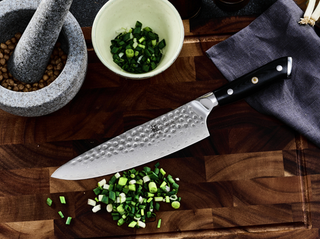
The Gyuto is Japan’s answer to the Western chef’s knife: built for all-purpose use in the kitchen, but it is usually sharper, thinner, and more agile. The blade length of a Gyuto knife is typically between 8 and 10 inches. The blade profile is curved from heel to tip, and the tip is pointed, fine, and ideal for precision.
The blade length of a Santoku knife, on the other hand, typically does not exceed 7 inches; the blade profile is flatter with a much gentler curve, and the tip is less pointed and more rounded.
Gyuto vs Santoku: Blade Length and Key Features
| Feature | Gyuto | Satoku |
| Blade length | 8–10 inches (210–240mm) | Typically 5–7 inches (165–180mm) |
| Blade profile | curved from heel to tip | Flatter belly with a gentle curve |
| Tip shape | Pointed, fine, |
Less pointed, more rounded |
| Blade thickness | Thin and lightweight (compared to Western chefs’ knives) | Taller blade |
| Balance | Often slightly forward-balanced | More balanced, neutral, and nimble |
Kyoku Gyuto Knives: Perfect Gyutos For Your Kitchen
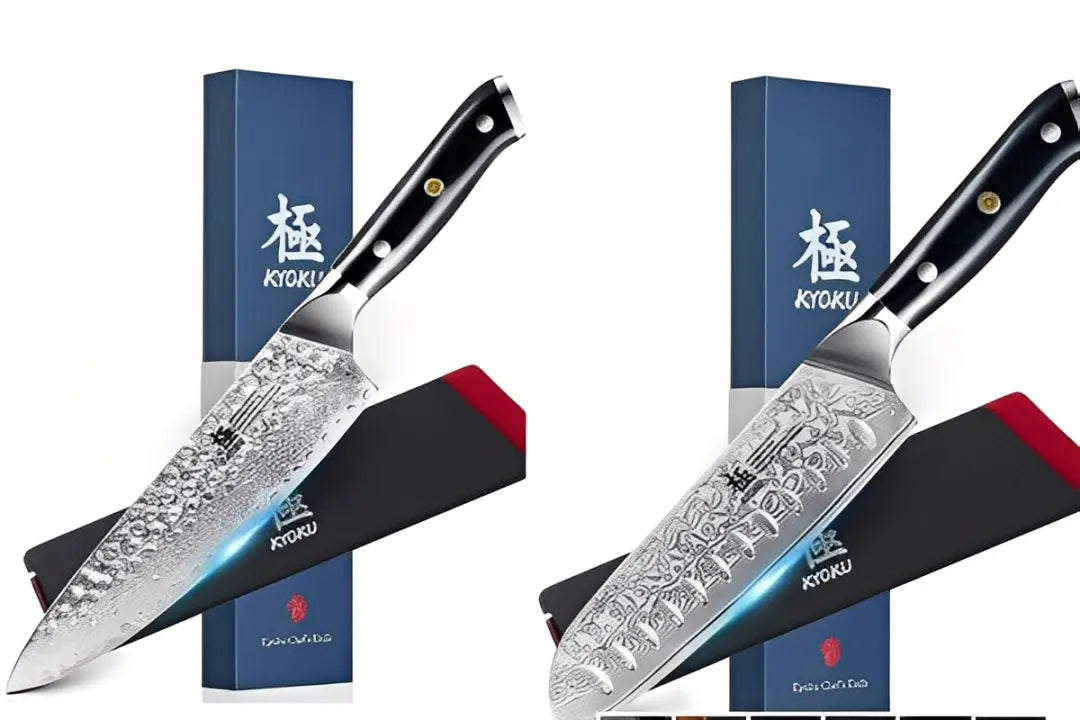
Kyoku Gyuto knives are designed to be workhorses-fast, versatile, and capable across nearly every task you’d do in a home kitchen. The most popular Gyuto knives are from the Gin Series and Samurai Series, and they are made from ultra-premium steel, from Damascus steel to Japanese VG10 steel.
The 8" Gyuto Chef Knife is meticulously crafted from cryogenically-treated Japanese VG-10 steel (58-60 HRC) with 66-layer Damascus cladding. This versatile knife features
- A razor-sharp 8-12° edge perfected using traditional Honbazuke sharpening
- An ionic silver coating for antibacterial protection
- A full tang ergonomic fiberglass handle
The ultimate all-purpose knife for effortless slicing of meats, vegetables, and fruits. Backed by Kyoku's lifetime warranty and 24/7 customer support
Gyuto vs Santoku Knives: Essential Uses
Gyuto knives and santoku knives are designed for different uses, and this much is evident in the details of their physical design: the Gyuto is for all-purpose use, and the Santoku is more specifically for slicing, dicing, and chopping.
The Santoku is designed with specific features to enable it to excel at cutting tasks that involve three things: slicing, dicing, and chopping. The Japanese phrase “Santoku” translates to “three virtues,” which are slicing, dicing, and chopping.

Gytuo vs Santoku: Best Uses
| Guyto | Santoku |
| Rock chopping | Up-and-down chopping and straight cuts |
| Fine tip work: trimming fat or scoring meat | Vegetable prep: onions, carrots, potatoes, etc |
| Slicing larger ingredients: melons, cabbage, etc | Smaller ingredient slicing: herbs, tofu, cheese, etc |
| General prep for a wide range of meals | Perfect for small kitchen use. |
The differences in purpose between Gyuto and Santoku knives become very apparent when using each knife, and they are seen in the feel of the knife in your hand and how it performs in different, specific cutting tasks.
- A Gyuto Knife, with its curved blade, performs better than a Santoku when it comes to rock chopping, and is, overall, better for fine tip work like trimming fat.
- A Santoku, on the other hand, outperforms a Gyuto for up-and-down chopping and straight cuts, and is exceptional for vegetable prep.
Kyoku’s Santoku Knives: Santokus For All Uses
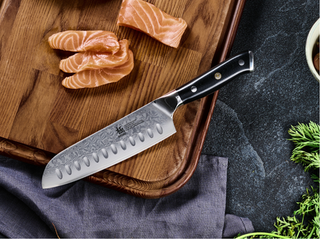
Kyoku’s Santoku knives are compact, easy to control, and ideal for cooks who mostly work with vegetables or want an easy, everyday knife that never feels intimidating. The most popular models are from the Gin series and the Shogun series.
The 7" Santoku Knife VG10 Damascus Steel is one of Kyoku’s best, and it features a 7-inch multi-purpose blade that delivers professional performance for home chefs and culinary experts alike.
- Its protective silver ion coating prevents the growth of unwanted contaminants
- For extra durability, the 66-layer Damascus VG10 stainless steel blade extends to the entire length of the handle.
The fiberglass handle of this knife, with its signature mosaic pin, withstands cold, heat, and corrosion while offering a comfy and well-balanced grip to prevent fatigue and cramps even in professional settings.
Key Factors to Consider When Choosing Between a Gyuto and a Santoku
With a clear understanding of the differences in design and use between a Gyuto knife and a santoku knife, you are in a better place to decide between the two.
The essential factors to consider are cutting style, the types of ingredients you work with, your level of familiarity with Japanese Kitchen knives, and (sometimes) the size and length of your fingers.

1. Your Cutting Style
- If you rock chop, you’ll prefer the Gyuto, because its curved belly lets you glide the blade smoothly.
- If you chop up and down, especially for vegetables, the Santoku will feel more natural.
If you are more of a vegetables person, you might find more uses for a Santoku knife. You will find many knives for cutting vegetables in Kyoku’s collection.
2. The Types of Ingredients You Deal With
- The Gyuto is the better option if you often prepare larger ingredients like whole chickens (boneless), big cuts of meat, squash, or cabbage.
- A Santoku is perfect if most of your prep is vegetables, fruits, and boneless proteins.
4. Your Comfort Confidence Level
Comfort and confidence levels also come into play when choosing between a guyto and a Santoku knife.
- A Santoku feels smaller, lighter, and easier for many beginners.
- Gyuto is longer and more versatile, but can feel intimidating if you’re not used to an 8–10 inch blade.
If you are a beginner, lean towards the Santoku.
5. One-Knife-for-Everything vs. Specialized Efficiency
Another important criterion for deciding between a Gyuto and a Santoku is whether you want an all-purpose knife that can be used for anything, or a specialized knife to meet the particular needs you have in the kitchen.
- Choose the Gyuto if you want a single knife that can do absolutely everything.
- Choose the santoku if you want a compact everyday powerhouse optimized for produce-heavy cooking.
Gyuto vs Santoku: Which to Choose in Each Case
1. Choose a Gyuto if:
- You want maximum versatility
- You cook a wide variety of meals
- You want to slice, chop, mince, and trim with one tool
- You’re comfortable with a longer blade
-
You want a Japanese-style upgrade from a Western chef’s knife
2. Choose a Santoku if:
- You want something compact and easy to handle
- You prioritize vegetable prep
- You prefer up-and-down chopping over rocking
- You want a knife that feels nimble and beginner-friendly
- Your cutting board or kitchen space is limited

Gyuto vs. Santoku: Can You Consider Both?
Another option, which rarely comes up in these conversations about Gyuto vs Santoku knives, is that you can own, and this is a tremendous advantage, especially as you gain more experience, try out more ingredients and recipes.
Many home chefs find that the Gyuto and Santoku complement each other beautifully:
- A good 8" Gyuto Chef Knife becomes the main long-blade workhorse for meats, big vegetables, and tasks requiring a fine tip.
- A good quality 7-inch Santoku knife, meanwhile, becomes the go-to for quick weeknight vegetable chopping or prep that doesn’t require the length of a Gyuto.
You don’t need both; either one can serve as your main knife, but having both gives you a longer, more versatile blade (Gyuto), and a shorter, highly controllable everyday slicer (Santoku)
If you cook frequently, meal prep for family, or enjoy Japanese knives, owning both can unlock real efficiency.

Final Thoughts on Gyuto vs Santoku Knives
At the end of the day, choosing between a Gyuto and a Santoku is really about choosing the knife that fits your habits.
- If you want power, versatility, and a do-everything blade, the Gyuto is your champion.
- If you want control, compactness, and easy vegetable prep, the Santoku is incredibly satisfying.
And if you’re serious about building a smart home kitchen knife setup, there’s no rule against getting both-they will come in handy in the long run!
For more options, you might want to consider Gyuto vs Kiritsuke knives

