
When trying to remove rust from a Japanese knife, your objective should not simply be to “scrub the blade clean.” What you should be trying to achieve is to remove active rust while preserving the steel, finish, edge geometry, and overall integrity of the knife.
That distinction matters a lot when it comes to Japanese knives: they are often made from harder, thinner, and more reactive steels than standard kitchen knives. Using the wrong rust-removal method can easily scratch the finish, damage the cladding, dull the edge, remove protective patina, or even alter the blade’s appearance permanently. A gentle and controlled approach is usually the best strategy.
The good news is that most rust on Japanese knives can be removed safely if you identify the problem early and use the right method for the severity of the rust. Here are 3 ways you can easily do so.

First, Make Sure it is Rust, not Patina
When it comes to Japanese knives, it is very important to verify that the discoloration is active rust, not patina, and you must do this before trying to remove anything from the blade.
This is incredibly important because many people accidentally remove healthy patina while trying to “clean” their knife.
So, What Is Patina?
Patina is a natural oxidation layer that forms on carbon steel over time. If you frequently use your knife for cutting onions, protein, citrus, or hot meats, there is a good chance it already has some patina on it. On some knives, it appears as a blue-grey discoloration, and on some others, it appears as dark grey streaks, rainbow tones, or cloudy patches.
For Japanese carbon steel knives, patina is usually a good thing. It acts as a semi-protective layer that slows down further oxidation and helps reduce the likelihood of aggressive red rust forming later. Many chefs actually prefer a stable patina because it gives the knife character and protection.
Explore more on why patina is good for knives
Rust vs Patina: Key Differences in Appearance
| Rust | Patina |
| Orange, red, or brownish | Blue-grey, rainbow tones, or cloudy patches |
| Rough or textured | Smooth and superficial |
| Will flake or rub off on paper or a towel | Will not flake or wipe off onto a towel or paper |
Dealing with Rust vs. Patina
So, before scrubbing, wipe the blade with a clean paper towel.
- If it leaves an orange/brown streak, it is active rust and must be removed.
- If it leaves no color, it is a stable patina. A grey, blue, or black patina is completely normal for high-carbon Japanese steel. It acts as a shield against actual rust, so you should leave it alone.
 3 Effective Methods for Removing Rust From Japanese Knives
Not all rust requires the same level of treatment. Light surface rust can often be removed very gently, while heavier oxidation may require more aggressive approaches. The best strategy is to start with the least abrasive method first and only move to stronger methods if necessary.
1. The Baking Soda and Wine Cork Method
The baking soda and wine cork method is one of the safest, most popular, and most beginner-friendly methods for removing light rust on Japanese knives. It is also the safest kitchen-safe alternative that will not aggressively scratch your steel.
The baking soda and wine cork method works really well because baking soda is mildly abrasive and alkaline. It helps loosen surface oxidation without aggressively grinding away steel.
The wine cork is equally important. Natural cork is firm enough to apply pressure but soft enough to avoid scratching the blade heavily. It acts as a gentle applicator instead of using harsh steel wool or abrasive pads.

How to Use The Baking Soda and Wine Cork Method
Start by mixing baking soda with a few drops of water until it forms a thick paste like oatmeal. Then take the following steps:
- Apply the paste directly to the rust spots.
- Take a natural wine cork (best if it is slightly wet), press it down, and gently massage the paste over the rust. Remember to rub along the length of the blade rather than across it.
- Continue rubbing for several minutes with light pressure.
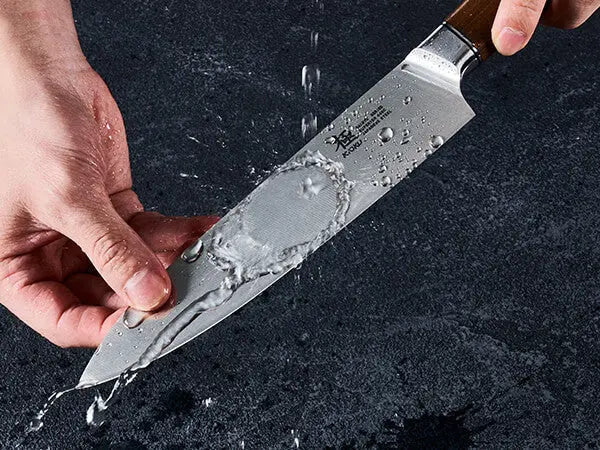
- Rinse the knife thoroughly when done.
- Then dry the knife immediately and completely.
Take note that when using this method, it is wiser to repeat the process multiple times rather than increasing pressure aggressively. This method works slowly, but that is part of what makes it safe for high-quality Japanese knives.
2. The Bar Keepers' Friend Slurry Method
This method is stronger and more aggressive than baking soda, but still commonly used by knife enthusiasts and professional cooks. It is best for removing rust that is slightly set in.
This Bar Keeper’s Friend Slurry method works because Bar Keeper's Friend contains oxalic acid, which is highly effective at dissolving oxidation and rust staining. When turned into a slurry with water, it can remove moderate rust, dark oxidation, stubborn staining, and even surface corrosion.
It works faster than baking soda and is particularly useful when rust has been sitting longer or has spread more extensively.

How to Use It
- Sprinkle a small amount of Bar Keepers Friend into a bowl.
- Add a few drops of water to create a paste-like slurry.
- Apply the slurry gently using a soft cloth, sponge, or cork.
- Rub lightly along the blade’s length.
- Avoid excessive scrubbing near the edge.
- Rinse extremely well.
- Dry the knife immediately.
Afterward, many users apply a small amount of food-safe mineral oil or camellia oil to protect the blade.
The key with Bar Keepers Friend is moderation. You want enough abrasion to remove rust without unnecessarily stripping the steel or finish. This method should be used with care on highly polished or mirror-finish blades because it can alter the finish slightly.
Use Japanese Sabitoru Rust Erasers
For recurring or deeper surface rust on Japanese knives, many collectors usually recommend that you buy a Japanese Sabitoru rust eraser. Sabitoru rust erasers are purpose-built Japanese rust removal tools, and they are designed specifically for knives and edged tools.
This method works largely because of the Sabitoru rust erasers: they function similarly to a very fine abrasive block in that they can gently abrade away oxidation while allowing you to target specific rust spots accurately. Different grit levels are available depending on how severe the corrosion is.
 Compared to random abrasive products, Sabitoru erasers are designed specifically for Japanese blade steels and finishes. They are extremely popular among knife enthusiasts because they offer more precision and control than household cleaning products.
How to Use Sabitoru Rust Erasers
- Wet the blade lightly.
- Rub the rust eraser gently over the rusted area.
- Work along the direction of the blade finish.
- Use consistent, controlled pressure.
- Wipe away residue periodically.
- Rinse and dry thoroughly afterward.
Many people use light oil or water as lubrication during the process.
Important Cautionary Tips for Using Japanese Rust Erasers
Rust erasers are abrasive; they will leave fine satin scratch marks behind. Use a "fine" or "medium" grit eraser and avoid scrubbing any aesthetic hammered finishes (tsuchime) or blacksmith coating. Sabitoru rust erasers are excellent for spot rust removal, medium rust, touch-up maintenance, restoring neglected carbon steel knives, and precision cleaning.
They are especially useful for people who own multiple Japanese knives and want a reusable long-term maintenance tool. For many enthusiasts, Sabitoru erasers become the preferred middle ground between extremely gentle home remedies and more aggressive polishing compounds.

Top Signs of Rust-Resistant Japanese Knives
Some Japanese knives are far more rust-resistant than others. Understanding why can help you choose a knife that matches your maintenance preferences. Rust resistance mainly comes down to steel composition and blade construction.
1. Stainless Steel Composition
The biggest factor that determines the durability of a knife is whether it is made of stainless steel. Stainless steel is good for knives because it contains enough chromium to form a protective oxide layer that slows rust formation dramatically. The most common rust-resistant Japanese steels are VG-10, AUS-10, Ginsan (Silver 3), SG2/R2, AND Swedish stainless steels. These steels are far less reactive than traditional high-carbon steels like White Steel or Blue Steel.
2. Clad Construction
Many Japanese knives use stainless cladding over a carbon steel core. In these knives, the cutting edge may still be reactive, and the outer blade faces are more rust-resistant. This greatly reduces maintenance demands while preserving carbon steel cutting performance. A knife with stainless cladding is often a great compromise for beginners.
3. Mirror or Polished Finishes
Highly polished blades tend to resist rust slightly better because smoother surfaces trap less moisture and debris. Rough kurouchi or heavily textured finishes can still be excellent, but polished finishes are often easier to wipe clean and maintain.
4. Manufacturer Descriptions
Japanese knife makers are usually very clear about whether a knife is carbon steel, semi-stainless, or stainless. If the knife description emphasizes “reactive steel,” “patina development,” or “high-carbon core,” it likely requires more careful maintenance.
4. Lower Reactivity During Use
One practical sign is how the knife behaves during cooking. Highly reactive knives may discolor rapidly, develop metallic smells, and rust quickly if left damp. More rust-resistant knives tolerate acidic ingredients and moisture much better.
Tips for Preventing Your Japanese Knife From Rusting
Preventing rust is much easier than removing it, especially when it comes to Japanese. Most rust problems come from small habits repeated consistently over time.
- Wash and dry immediately: Never leave a Japanese knife sitting wet in the sink.
- Avoid dishwashers completely: Dishwashers are extremely harsh on Japanese knives.
- Use food-safe oil for long storage: If the knife will sit unused for extended periods, apply a thin coat of camellia oil, food-safe mineral oil, or tsubaki oil.
- Store the knives properly: Avoid storing knives loosely in damp drawers. Instead, use saya covers, magnetic strips, knife rolls, and dry knife blocks.
- Build a stable patina: For carbon steel knives, allowing a healthy patina to develop can help reduce future rusting.
Many experienced users intentionally encourage patina formation through normal cooking use because it stabilizes the blade surface over time. Trying to keep carbon steel looking permanently shiny often creates more maintenance work and more rust problems.
 Final Thoughts on Getting Rust Off Japanese Knives
Rust on a Japanese knife is not necessarily a disaster. In many cases, it is completely manageable if caught early and treated correctly. The most important step is identifying whether you are looking at harmless patina or active rust. From there, choosing the appropriate removal method helps preserve the knife’s finish, geometry, and long-term performance.
For light rust, the baking soda and wine cork method is gentle and safe. For more stubborn oxidation, Bar Keepers Friend can work extremely well when used carefully. And for precise maintenance, Japanese Sabitoru rust erasers remain one of the best purpose-built tools available.
You may also be interested in our general guide on how to clean, sharpen, and store your Japanese knives.

